
NERVOUS SYSTEM TRACKING
THE INTENTION
Understanding the language of your nervous system is the first step in intentionally creating a life you love. Your nervous system is the literal foundation of your human experience—its state dictates the quality of your perception and responses to the world around you. The beauty of this system is its plasticity—you have the power not only to shift your state in the present moment, but to rewire your automatic responses to align with your desired life.
This process requires repetition. Rather than letting that discourage you, look at every repetition as a fresh opportunity to discover a new layer of yourself. It all begins with attunement—the ability to deeply notice and accurately respond to your own physiological and emotional needs. Without this skill, you may be unaware when old wounds and unmet needs jump in the driver’s seat, causing you to react from the past instead of responding to the present. This work is complex and full of nuance, yet I hope this simplified guide can support you in moving from cycles that no longer serve you into cycles that align you with your health and life goals.
HEALTHY CYCLES
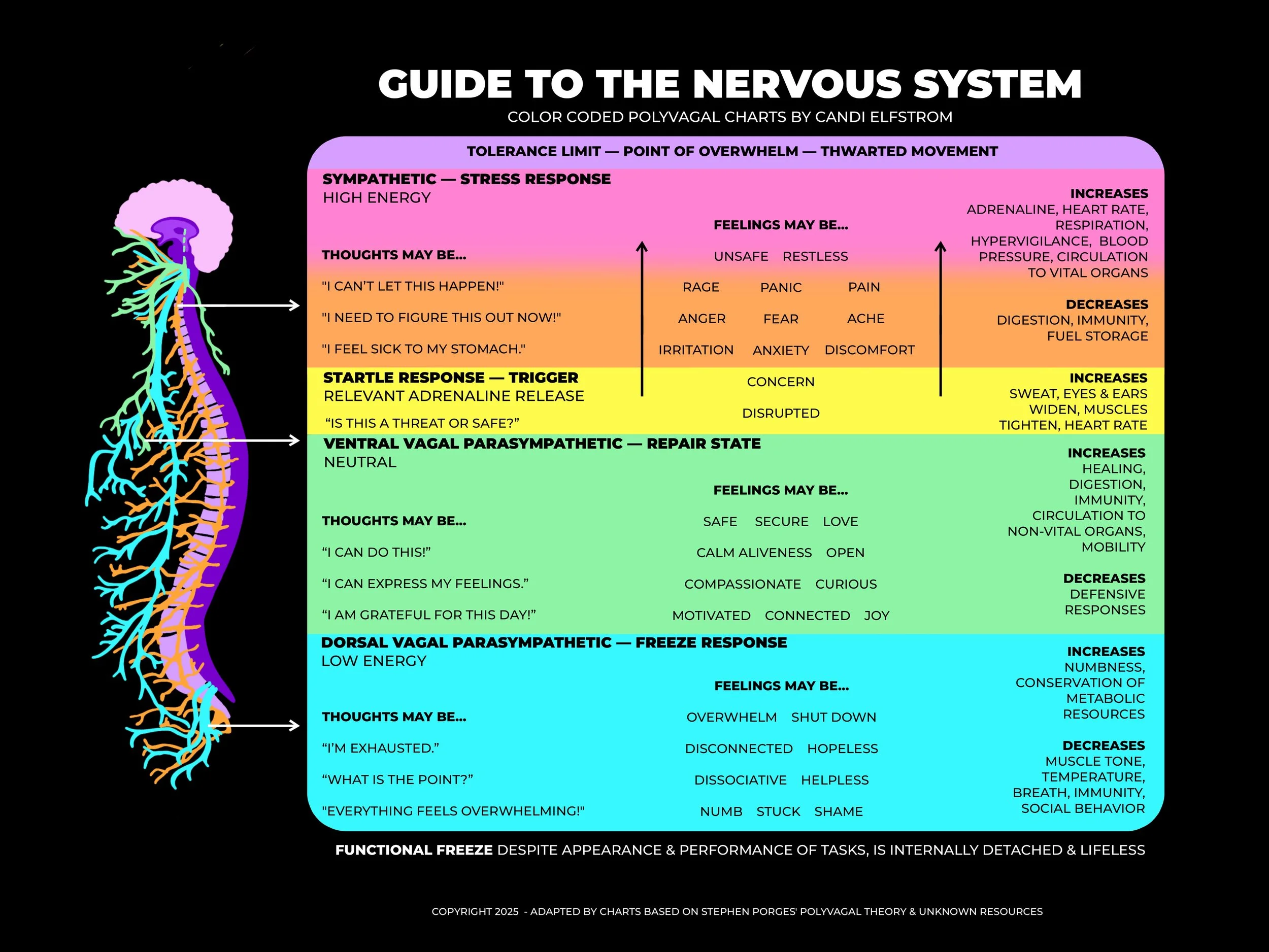
A healthy nervous system cycle will flow in between the repair state (ventral vagal) and a stress response (sympathetic). Remember, positive and negative stress have the same response. In this cycle, you have a greater capacity to heal and use your stress to create your desired life.
TRAUMA CYCLES
Depending how a trauma impacts one’s unique nervous system, it can change their baseline. They can cycle between a stress response (sympathetic) and a freeze response (dorsal vagal), spending little time in a repair state (ventral vagal). One traumatic experience can lead to PTSD, while multiple occurrences can lead to Complex PTSD, or other health challenges.
ATTUNEMENT
Attunement starts with developing your interoception. This is your body’s ability to perceive internal signals like heart rate, temperature, and muscle tension. While our brains are constantly perceiving these signals, a culture of chronic stress often disconnects our conscious minds from them. When we lose the ability to notice what is happening inside, we often make choices we later regret.
As you build your capacity to sense and attune to yourself, you gain an internal compass. You begin to notice exactly when a trigger arises or when your system needs to slow down. By tracking your physical sensations, emotions, thought patterns, and reactions, you start to bridge the gap between your body’s signals and your conscious awareness. This is where you can authentically and intentionally be you.
HOW TO USE THIS TRACKER
I encourage you to set aside time each day to use the prompts below to pause and check in, especially when you feel a strong emotion or physical shift. The goal here is awareness, not perfection. Use this tracker as a tool for self-curiosity, never for criticism. If you miss a day, simply pick up where you left off. You aren't "fixing" yourself—you are learning to compassionately listen to the sacred language of your own internal ecosystem in order to create the life and relationships you desire.
THE 5 STEP CHECK IN
1. NOTICE by gently scanning down your body bringing your awareness to any sensations or emotions that you can notice. Find their location within. (view body sensation list for help)
2. DESCRIBE the sensation or emotion in your body using color, shape, size, or texture.
(ex - black, small blob in my stomach)
3. ACKNOWLEDGE what is here through non-judgmental presence and gentle touch as wanted. (ex - place a hand on your belly)
4. INQUIRE with curiosity, ask this part of you what it might need or how you could support it. (ex - maybe it needs to feel safe, to be held, to be heard, or to take a specific action)
5. OFFER support to the best of your current ability. If there was no clear request, simply offer a moment of stillness and make a commitment to recheck in at a later time.
SIMPLE REFERENCE
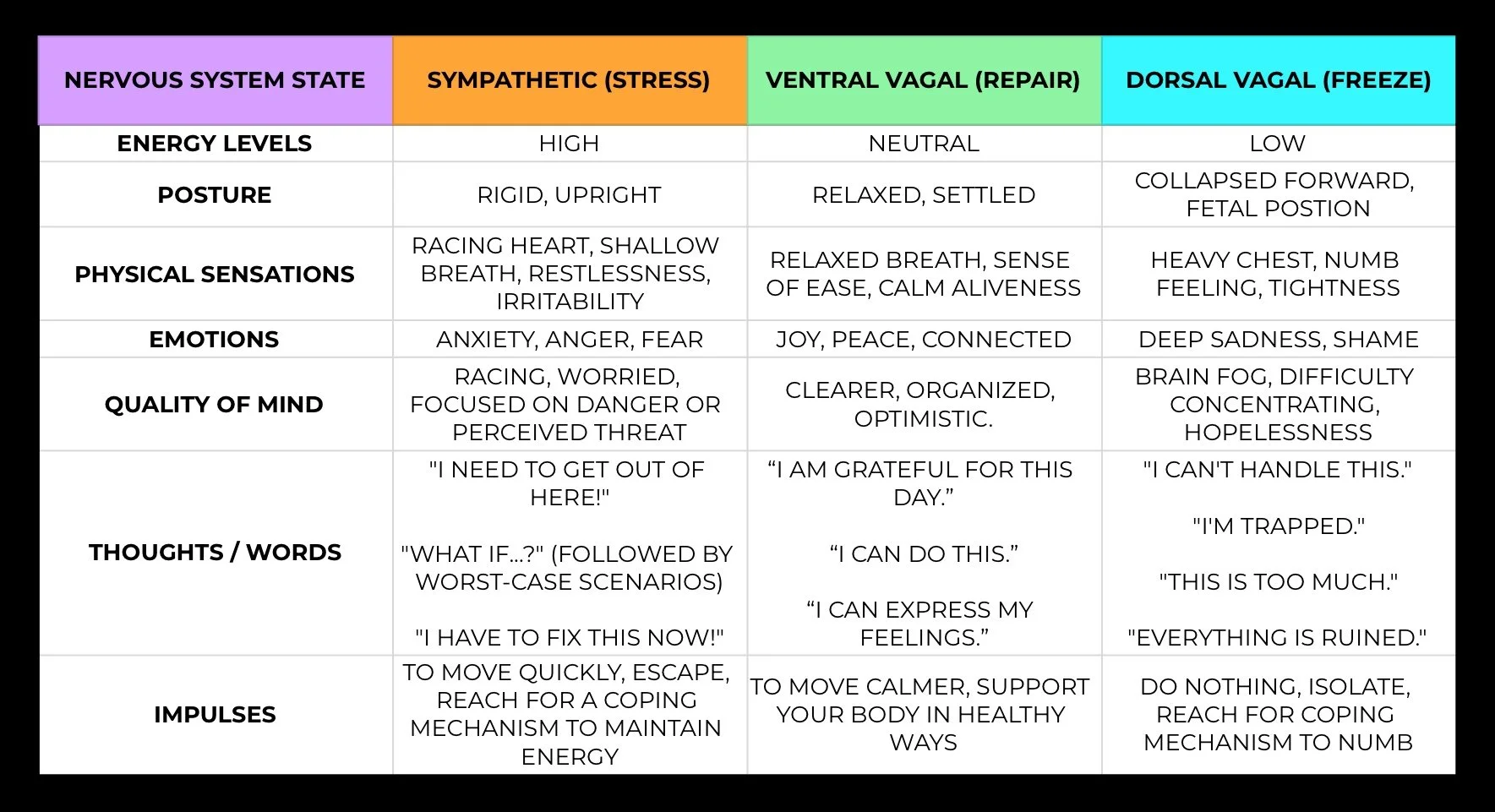
LANGUAGE OF THE NERVOUS SYSTEM
A LIST OF BODY SENSATIONS YOU MAY NOTICE WHILE TRACKING
YAWN
DEEP SPONTANEOUS BREATH
STOMACH GURGLE
RELAXATION
SMILE
TENSION / TIGHTNESS
WAVE
TINGLES
GOOSEBUMPS / CHILLS
HEAT
COLD
BELLY SOFTEN
JAW LOOSEN
HEAVY
HANDS UNCLASPING
SHOULDERS DROPPING
POSTURE GROWS
BREATH DEEPEN
CONNECTION
OPEN HEART
HEART RATE SLOWING
FLUSHING
FLUTTERS
BUZZY
NAUSEOUS
ACTIVATION
LIGHTNESS
4 WEEK TRACKER
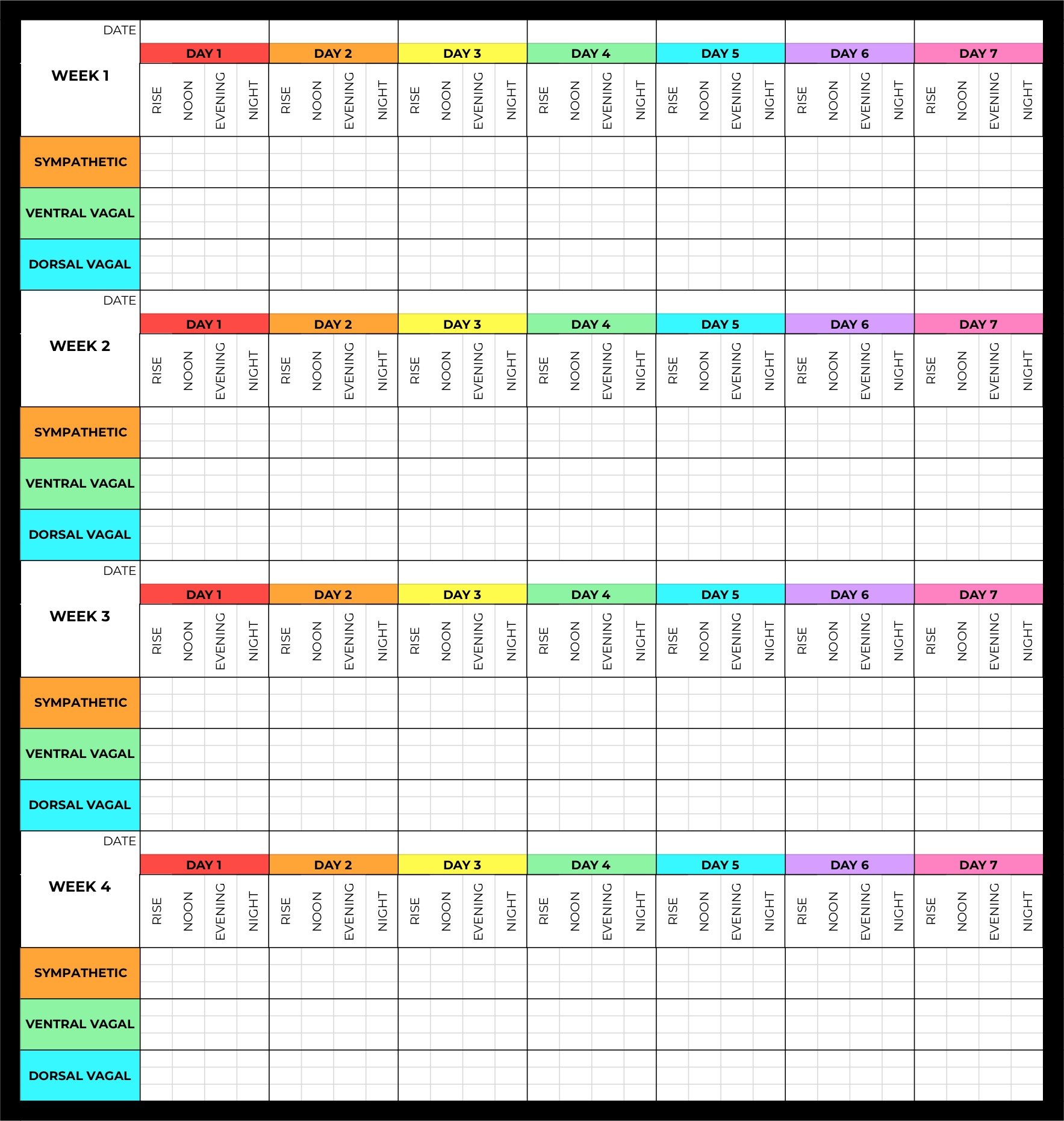
Use the 4-week tracker to record which of the 3 states you think you may be in. The 3 vertical boxes within each state represent a range of intensity. Simply shade, circle, or mark the box that best reflects the intensity of that state.
JOURNAL TRACKING
IN THIS MOMENT….
1. WHAT EMOTIONS AM I EXPERIENCING? (HAPPY, SAD, ANGER)
2. WHAT THOUGHTS AM I HAVING? ("IT’LL BE OK," “I CAN’T DO IT,” “WHAT WAS THAT?”)
3. WHAT SENSATIONS OR POSTURES DO I NOTICE MY BODY HAPPENING IN? (KNOT IN THROAT, COLLAPSING FORWARD, STRUGGLING TO MOVE, RELAXING)
4. WHAT IMPULSES FOR ACTIONS AM I HAVING? (SCROLL, EAT SOMETHING, ISOLATE, CALL A FRIEND)
5. WHERE IS MY ENERGY LEVEL AT? (HIGH, LOW, CRASHING, OKAY)
6. HOW WOULD I FINISH THE SENTENCE, "THE WORLD IS _____?" (EXCITING, AWFUL, BEAUTIFUL, SCARY)
7. HOW WOULD I FINISH THE SENTENCE, "I AM _____?" (UNLOVEABLE, ALONE, NOT GOOD ENOUGH, OKAY, STUCK, CONTENT)
8. WHAT STATE DO I THINK THIS IS? (VENTRAL VAGAL PARASYMPATHETIC, DORSAL VAGAL PARASYMPATHETIC, SYMPATHETIC)
9. IS THERE ANYTHING ELSE YOU’D LIKE TO JOURNAL OR RECORD?
YOUR TOOLBOX
Once you better understand the signals of your nervous system, you can better know what tools best support any stage you are in. These resources could be as simple as orienting to your environment when in Dorsal Vagal, exploring a somatic movement in Sympathetic, or enjoying time with a loved one in Ventral Vagal. Even the act of having your anchors written down is a form of support - it offers your system a predictable place to land when things feel overwhelming or uncertain.
To make this practice easier, I’ve created a FREE printer-friendly PDF of this guide. It includes everything mentioned above, plus a dedicated space to list out the tools that have made a difference for you. You don’t have to build your own charts or carry this all in your head. This is simply a quiet space for you to track your journey of understanding your system’s unique language.
Click the image below to download the FREE guide.
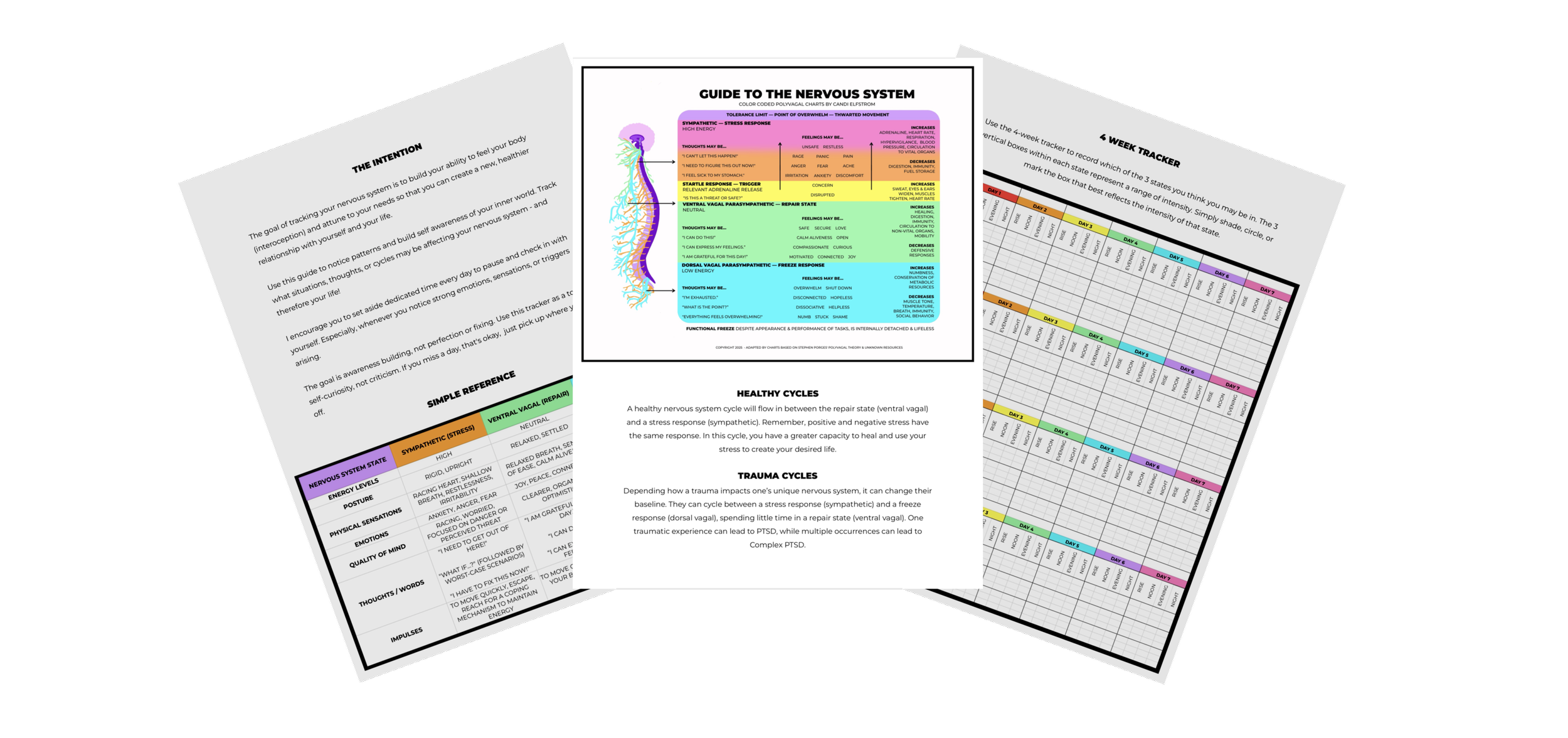
My Nervous System Tracking Guide is a compassionate tool designed to help you build a new, healthier relationship with yourself and your body.
This 7 page guide is focused on self-curiosity and awareness building, not perfection or fixing. It empowers you to become an active observer of your own internal experience so you can move from reactivity to intentional choice.
Inside, you’ll find…
A Polyvagal Chart to help you understand your nervous system and its states
A 5-Step Check-In process for gently navigating difficult emotions or sensations
Journal Prompts for deeper self-reflection
A 4-Week State Tracking Chart to visualize your nervous system’s patterns
Additional resources to understand the language of your nervous system
Ready to stop criticizing your body and start understanding it?
Download this FREE guide today!
(no credit info needed)